
Bloodletting, Wool and Wimbledon: A Blog Post for International Women’s Day
In this blog post for International Women’s Day, Cathryn takes a look at some of Newcastle’s historic women.
Matilda the Barber and Isolde of Pandon: Medieval businesswomen
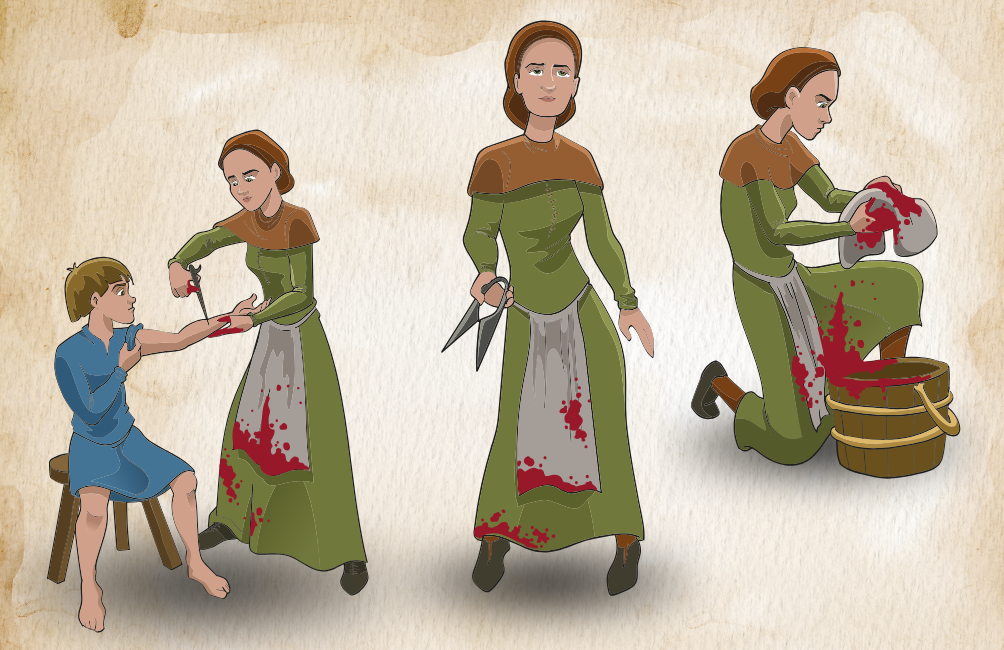
Firstly, we will look at Matilda the Barber and Isolde of Pandon, two businesswomen working in Newcastle during the Medieval period. Matilda worked, as you have probably guessed, as a barber in the late 1200s. She didn’t just cut hair or shave people; she was also a Medieval medic. As a barber surgeon, Matilda would have performed surgical procedures such as amputations alongside things such as tooth extractions and that Medieval cure-all bloodletting.
The red and white poles still used by barbers today reflects their historic work as surgeons. The red represents blood, whilst the white represents bandages. According to tax records from 1296 Matilda owned about £10 of property. This may not seem much to us, but at the time this was about the value of a craftsman’s house and shop, so Matilda’s business was clearly doing well.
The amount of property owned by Matilda isn’t the only thing that tells us her business was successful, she lived and worked close to the Castle, in the parish of St Nicholas, then the most prestigious parish in Newcastle.
The 1296 tax records also give us information about another successful Medieval businesswoman, Isolde of Pandon. Isolde worked in the wool trade alongside her husband Gilbert. In the Medieval era, wool was big business. In fact, at the time Newcastle’s main export wasn’t coal, it was wool. It was also the only port in England outside London that had a licence to export wool, so living just outside Newcastle (Pandon officially became part of Newcastle in 1299) meant that the couple were ideally placed to run a successful business.
Isolde and Gilbert would have mainly exported their wool to Flanders, then one of the main clothmaking centres in Europe. Isolde’s father was a Flemish wool merchant, so we can assume that this provided the couple with many business contacts on the continent.
After Gilbert’s death in 1287 Isolde took over the business. This wasn’t unusual it was common for widowed women to take over their husband’s businesses, and she continued to be successful trading on her own. Isolde wasn’t just a savvy businesswoman; she was savvy when it came to marriage too. Her second husband was the Italian merchant Gerardino of Lucca. Lucca was one of Medieval Europe’s most important centres of trade and banking so this marriage would almost certainly have benefitted the business.
By 1296 Isolde was worth £86, this made her the wealthiest person in Northumberland. Both Matilda and Isolde have their own blog posts, discussing more about their work and the times they lived in, so please check those out too.

Muriel Robb: Edwardian Sportswoman
Newcastle has its own Wimbledon champion, Muriel Robb who won the Women’s Singles title at the 1902 championships. Born in Jesmond in 1878, she was taught to play tennis by her parents on a court at the family’s home. The Robb family home was located very close to Jesmond Lawn Tennis Club, where Robb also played. During her time at Cheltenham Ladies’ College her talent for the sport was considerably developed.
She won her first major trophy in 1899 when she won the Welsh championship. In the same year, she competed at Wimbledon for the first time. She reached the quarter finals and would be knocked out at this stage in the 1900 and 1901 championships. By 1902 as well as the Welsh Championship, she also had the Irish and Scottish championships under her belt. In the final Robb was faced with a rather formidable opponent, Charlotte Cooper Sterry. Sterry had won the Women’s Singles title our times and would go on to win a fifth time in 1908. Sterry was also a double Olympic champion having won both the Women’s Singles and the Mixed Doubles events in 1900, (this made her the first woman to win a gold medal at the Olympics for an individual event; the first woman to win an Olympic gold was Hélène de Pourtalès who formed part of the Swiss sailing team).
The 1902 final was played over two days, with two sets being played before the match was abandoned due to rain. At the end of the first day both women had won one set each, Sterry won the first set 6-4, whilst Robb won the second set 13-11. When the players returned the following day, the committee decided that the final was going to be started from scratch, the first and only time this has happened at Wimbledon.
Robb beat Sterry 7-5, 6-1. Robb and Sterry played a total of 53 games over the two days, making it the longest women’s Wimbledon final in the history of the championships. This was Robb’s last appearance at Wimbledon; she played in one more tennis tournament before retiring from the sport due to ill health.
Muriel Robb died in 1907 from cancer at the age of 28. She was buried in Jesmond Old Cemetery, and it was reported that there were so many wreaths at her funeral, they had to be transported in two lorries. She is the only Wimbledon champion to hail from the North East of England, and the youngest Wimbledon Singles champion to die.

So there we have it a look into some of the women who have featured in Newcastle’s history.