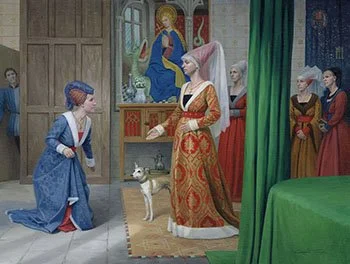
The Woman who Would be Queen: The Life of Cecily Neville, Duchess of York
In this blog post, Cathryn takes a look at the life of Cecily Neville, Duchess of York.
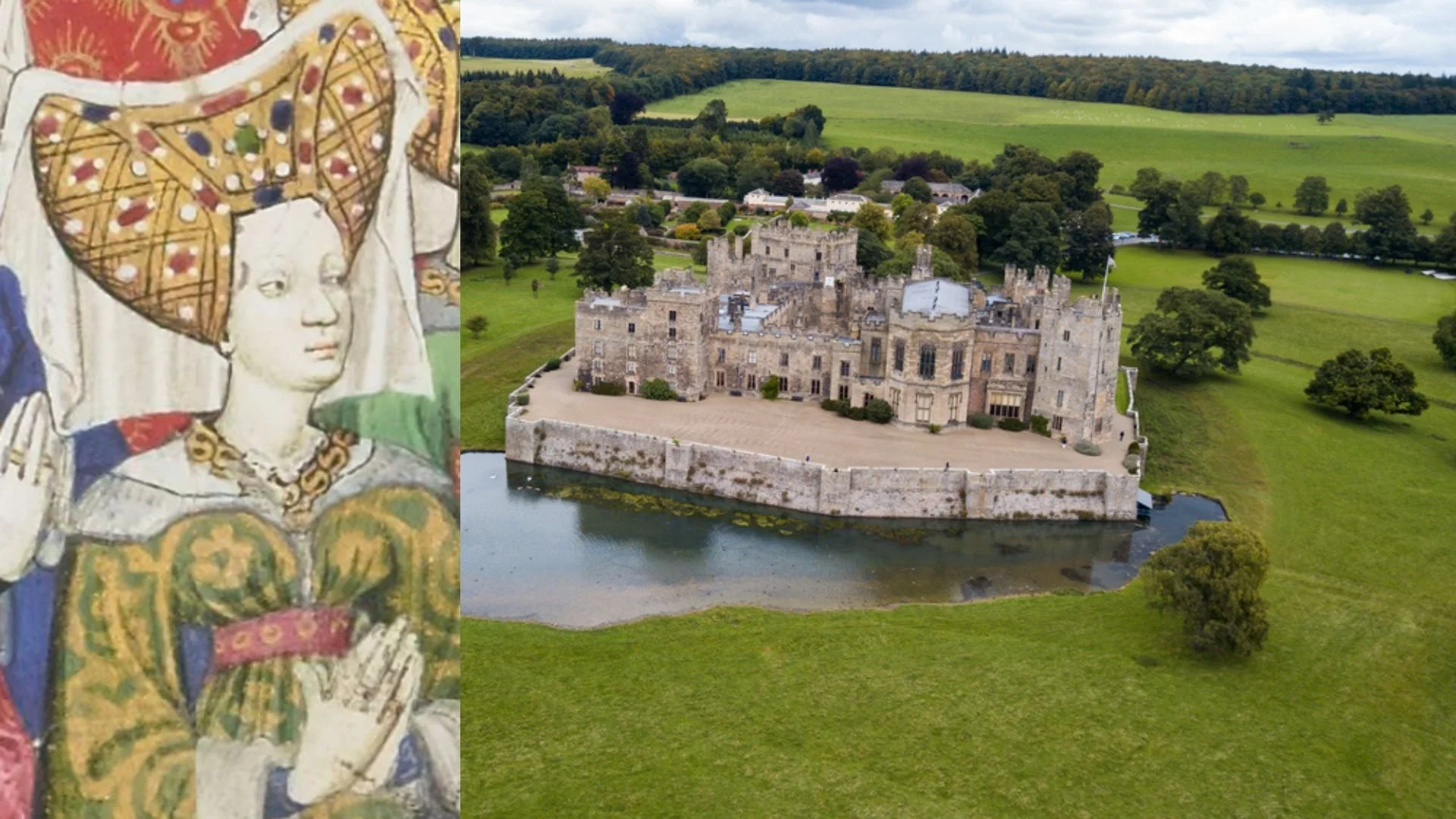
Born at Raby Castle in County Durham in May 1415, Cecily Neville was the youngest child of Ralph Neville, 1st Earl of Westmorland and his second wife Joan Beaufort. On her mother’s side Cecily was a great-granddaughter of Edward III via his third surviving son John of Gaunt and his third wife Katherine Swynford. She married Richard Plantagenet, 3rd Duke of York in 1429 and in 1439 their first child, Anne of York, Duchess of Exeter was born. In total Richard and Cecily would have twelve children, seven of whom reached adulthood.
In 1436, Richard was made commander of the English forces in France following the death of the Duke of Bedford. Richard assumed that he would become the unofficial regent in France, (Henry VI was underage at the time), but following a long period of negotiation he took the less powerful role of King’s Lieutenant, and in 1441 Cecily accompanied her husband to Normandy. She may also have travelled to France with him ten years earlier for Henry VI’s coronation as king of France, but this is not certain. Later, in 1449 Cecily would accompany her husband to Ireland after his appointment as Lieutenant of Ireland. Although a tenure of some time was planned for, York returned to England rather quickly, citing a lack of funds, (he owed the crown around £38,700. Despite his return to England, he would stay in the post of Lieutenant of Ireland until 1453.
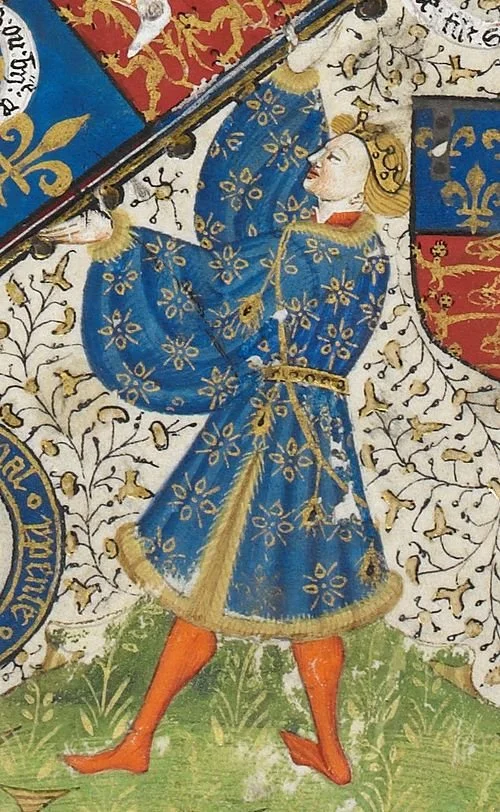
The couple would begin to play a bigger role in English politics in the 1450s. Richard would make at least two attempts in 1451 and 1452 to be recognised as Henry VI’s heir, (the king was childless at the time). Whilst Richard’s political influence would wane in the early 1450s, the king’s health would greatly increase it again.
In August 1453 Henry VI had some form of nervous breakdown, likely catatonic schizophrenia. News of the English defeat at the Battle of Castillon has been suggested as the likely main trigger for Henry’s illness. The defeat saw the loss of all the English possessions in France, save Calais.
Although Henry’s mental health had been declining since the late 1440s, with critics questioning his ability to rule by the end of the decade, the 1453 episode left the king unable to rule. During his illness, Henry became completely unresponsive to anything going on around him, even the news of the birth of his son Edward of Westminster or that of the death of the Archbishop of Canterbury, John Kemp a few months later failed to get a response. London merchant John Stodeley described Henry’s reaction when he was first introduced to his newborn son, “He looked on the prince and cast down his eyes again.” Giles Chronicle describes the illness as follows, “for a whole year and a half he had neither natural sense nor reason capable of carrying on the government.” Henry’s illness would end around late 1454 or early 1455.
The king’s illness combined with the young age of his son led to a power vacuum and massive instability. When it became clear that Henry’s illness was going to be long-lasting the Duke of York was appointed Protector of the Realm and Chief Councillor in late March 1454, whilst Cecily’s brother Richard Neville, 5th Earl of Salisbury was made Chancellor.
When Henry recovered the Yorkist faction was removed from power, battlelines having been firmly drawn between the Duke of York and Henry’s Consort Margaret of Anjou.
In 1455 the Wars of the Roses began with the First Battle of St Albans. The battle saw a Yorkist victory and Henry VI was taken prisoner. The Duke of York had himself made Protector once again, although apart from his wife’s family he had little support from the nobility. For the rest of the 1450s an uneasy peace was maintained. After the Lancastrian victory at the Rout of Ludford Bridge, York fled to Ireland with his second son Edmund, Earl of Rutland. His eldest son, Edward, Earl of March fled to Calais alongside the Earls of Salisbury and Warwick (the 16th Earl, Richard Neville, better known as ‘The Kingmaker’ and Cecily’s nephew). At this time Cecily and her younger children were residing at Ludlow Castle. She was able to obtain pardons for several of York’s men and was placed under house arrest with her sister Anne, Duchess of Buckingham. Also, when her husband was attained by parliament, she was able to secure financial support for herself and her younger children.
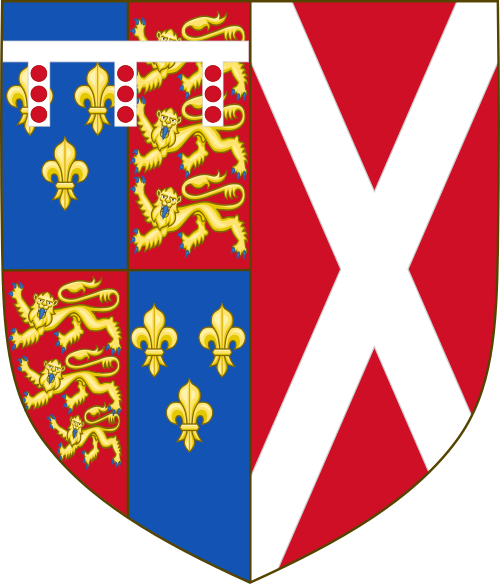
1460 saw Cecily move to Southwark to become the London figurehead of the Yorkist movement, it also saw the death of her husband following the Lancastrian victory at the Battle of Wakefield. His head was placed on the Micklegate Bar in York, topped with a paper crown. By the time of his death, the Duke of York had made his ambitions for the crown clear and Cecily changed her coat of arms to include the Royal Arms. His eldest son Edward now took up the Yorkist claim. He was declared King the following year, becoming Edward IV. Until 1464, when he married Elizabeth Woodville, Cecily took the role of premier lady at the Royal Court. Although she took a step back following the marriage, she continued to be a part of court life until 1478 when her son George, Duke of Clarence was executed. Whilst her retirement from court life may have been caused by the death of her son, she may also have chosen to move on from court life due to her age, she was then in her early sixties.
It is unknown what she made of her youngest son Richard taking the crown in 1483, she did not attend his coronation, and both supporters and detractors of Richard III have used her absence to support their views. Although she outlived all but two of her children, and several of her grandchildren, Cecily did live long enough to see the births of three of her great- grandchildren. (Arthur, Margaret and Henry Tudor). She died at the age of 80 in 1495, having seen two sons (Edward IV and Richard III), and a grandson (Edward V) as reigning monarch. She also saw a granddaughter and a great-niece as Queens Consort (Elizabeth of York and Anne Neville, Consorts to Henry VII and Richard III respectively).