
Bringing a castle rogue out of the shadows: The case of “Black Jackey” Johnson
In this blog post, Amanda delves into the story of one of the rogues of the castle Garth: The “sorcerer” and “wizard” known as “Black Jackey” Johnson…
In a time when religion and superstition could, and frequently were, used to explain phenomena, rogues such as 'Black Jackey' Johnson could earn a living selling spells and claiming to read people's minds. Also known as 'Black Jock', he proclaimed himself to be a wizard and was well known on Dog Bank as a sorcerer and a master of the dark arts. People would call on him for any number of reasons – if you'd been cheated, had a curse upon you, or even for a love spell. Black Jackey was the person to turn to, as long as you could pay his fee.
Jackey claimed that he owned a copy of the great magician Cornelius Agrippa’s manual of the dark arts. With the tools of his trade – his grimoire, his cards, a mirror, and his mind – Black Jackey claimed to be able to read minds and weave spells to find the truth of any situation. Such was his reputation and power over the local population that it was said that if members of the criminal underclass heard that someone was consulting with Jackey, they would return stolen goods, afraid of the consequences of his involvement.
The authorities did not like having Jackey around and he was eventually exiled to Byker, where he continued to weave his magic.
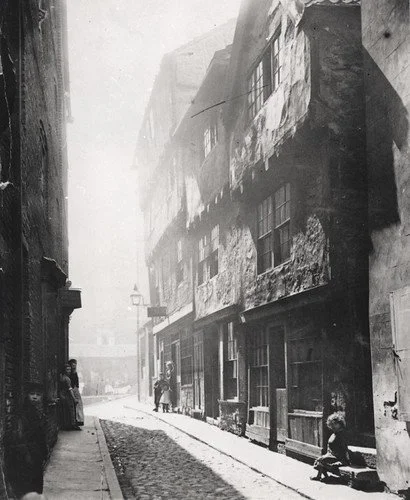
A view of Dog Bank Newcastle upon Tyne taken c.1890. ,Courtesy of Newcastle Libraries.
Jackey's spells were not for the faint-hearted. For those visiting him for help in courtship, he would offer the following guidance to make themselves invisible, thus enabling them to visit their lover without her family being aware. First, one must find a completely black cat, one without a single white hair on its body. On a Sunday, during the time when one was meant to be in church, you must boil the cat for three hours. Cut out the cat's heart and dry it out in a previously unused oven until it turned to a fine powder. The powder then had to be concealed in a churchyard and visited each night for seven consecutive nights at precisely midnight. On the seventh night, you would then meet a mysterious character who would walk with you to the gate. You must give them half of the powder and keep the other half for yourself. From then on, you would be invisible whenever you carried the powder.
With such complex instructions and no margin for error, it was unsurprising that not everyone was able to follow them sufficiently well to ensure a successful outcome.
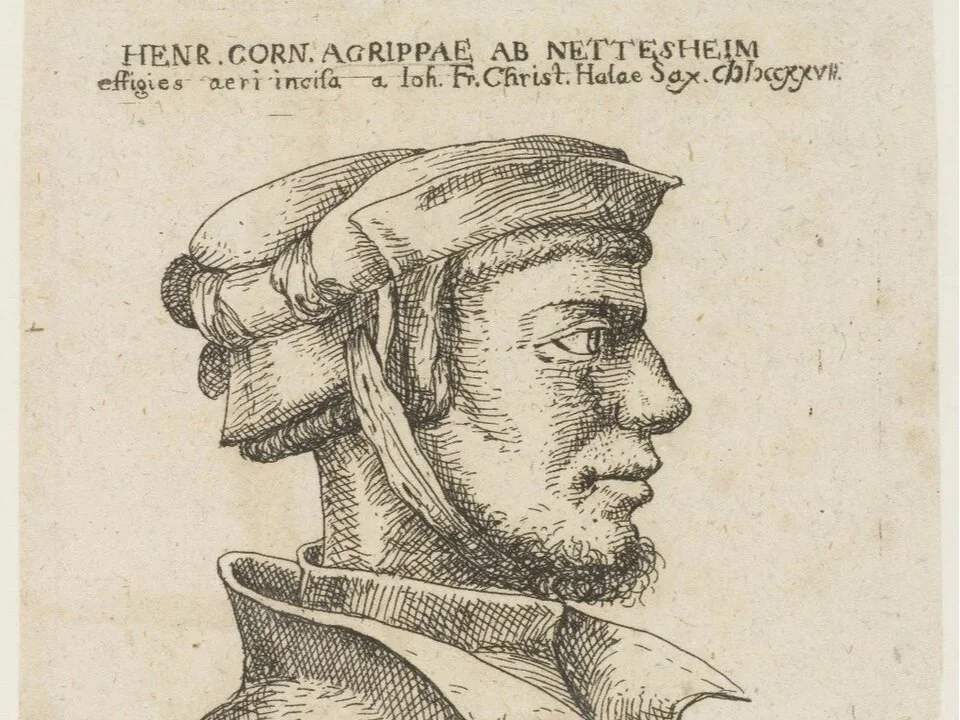
Etching of Heinrich Cornelius Agrippa von Nettesheim, whose occult ways Black Jackey Johnson was said to follow.
One such example was detailed in Notes on the Folk-lore of the Northern Counties of England and the Borders, where the Rev. J. F. Bigge gave an account of a farmer, one William P. of Richmond Hill, who had consulted with 'Black Jock' concerning a horse of his which had become unwell and died in such an unusual way that he assumed that it was the work of an 'unhallowed charm' or the 'evil eye'. Upon listening to the tale, 'Black Jock' is reported to have announced that the horse had been killed by poison administered in brewers' grains. For a fee of one pound, he gave the farmer instructions to follow to discover the poisoner. He was to cut out the heart of the horse, fill it with pins, and roast it upon a fire in the house between 11pm and midnight. It was vital, however, that he first block every opening to the outside, from doors and windows down to the tiniest crack or crevice in the walls. At midnight, he was to open the door and he would see the form of whomever had poisoned the horse.
The farmer dutifully followed the directions to the best of his ability with the assistance of his servant. However, upon opening the door at midnight, they saw 'one of the most respectable and kindly disposed among their neighbours', whom they could not possibly accuse of such a crime. Concerned by the outcome of the spell, the farmer revisited 'Black Jock', who came to the farmhouse himself. He found a small round hole in the stall which opened to the outer air and proclaimed that since they had not followed the spell correctly, they would not be able to discover the true perpetrator of the crime.
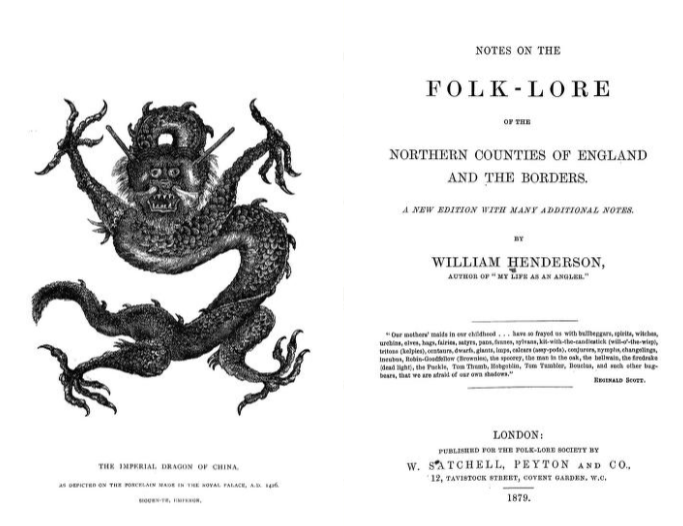
Title page of “Notes on the folk-lore of the northern counties of England and the borders”, by Henderson, William, 1813-1891. Courtesy of the Internet Archive
A contrasting account from Durham was cited in defence of the spell’s effectiveness. In that case, a farmer was said to have successfully identified the cause of his horse’s illness as the work of 'evil spirits', even hearing their presence after faithfully following the same instructions. Such stories were taken by some as evidence that where the ritual failed, as in William P.’s case, the fault lay not with 'Black Jock' himself, but with some overlooked detail in its execution.
Despite this unfortunate customer, it is clear that 'Black Jackey' remained a powerful figure right up until his death in 1837 at his home in Byker. He is said to have died while reading tarot cards and is reported to have remained motionless for several days before falling over dead.
Today, it is difficult to separate fact from embellishment in the tale of 'Black Jackey', but his legend survives in the stories that outlived him. In the shadows of Dog Bank and Byker, he remains a reminder of a time when magic and everyday life were not so easily distinguished.